
Dodging the spittle

International body demands an end to Israel’s illegal presence in the Palestinian territories within 12 months.
The United Nations General Assembly (UNGA) has overwhelmingly adopted a resolution calling on Israel to end its illegal occupation of the Palestinian territories within a year, a move that Palestine hailed as “historic”.
The nonbinding measure passed a 124-14 vote on Wednesday, with 43 countries abstaining.
The UNGA demanded that “Israel brings to an end without delay its unlawful presence in the Occupied Palestinian Territory, which constitutes a wrongful act of a continuing character entailing its international responsibility, and do so no later than 12 months”.
It also called on Israel to make reparations to Palestinians for damages incurred by the occupation.
The UNGA, whose mission includes promoting “respect for human rights and fundamental freedoms”, includes every sovereign country in the world, so Wednesday’s vote underscores the depth of the international opposition to the Israeli occupation of Palestine. (more...)
UN General Assembly overwhelmingly calls for end of Israeli occupation

Experts say Quebec won’t enforce environmental laws on Mohawk land as Kanesatake deals with numerous dump trucks with unknown contents driving in every day.
The people of Kanesatake want to know what’s being dumped on their land.
Every day, from sunrise to sunset, trucks filled with dark brown soil rumble onto the Kanien’kehá:ka (Mohawk) territory and unload their cargo by the Lake of Two Mountains.
After decades of inaction from all levels of government, local whistleblowers have gone vigilante: installing trail cams next to dump sites, flying drones overhead, surreptitiously gathering soil samples and — in one case — firing a gun into the air to scare off a trucker.
But still no answers.
On Monday, The Rover recorded three trucks loading what appeared to be contaminated soil from construction sites in Laval and dumping them onto a plot of Mohawk land that overlooks the lake.
The first picked up slabs of asphalt from an industrial building near Highway 440 while the others loaded soil from a condo development in east Laval. All three then headed northwest to Kanesatake and unloaded their cargo near the shoreline.
These shipments all belong to Nexus Construction, a Laval-based excavation company that dumps dozens of truckloads on the reserve every day, according to Kanesatake Grand Chief Victor Bonspille and the community’s environmental protection agency. (more...)
Dump Site Openly Flouts Provincial Law

Nikolay Tarasenko has been building an Orthodox Church on a mountain in his hometown of Kamenka, in Lugansk People’s Republic since the 1990s. Nikolay, his family members and locals – have all participated in the construction process. When the war broke out in the Donbass in 2014, the project continued regardless. The church’s domes were built under constant shelling. “Then the attack started and they dropped about 70 guided aerial bombs on the Church. The heaviest of these bombs weighed in at 250 kilogram. About 18 of such heavy bombs were dropped, but not a single fragment reached the church. Not a single one,” says Nikolay.
Despite the fact that Nikolay is building a church, he stated that he “wouldn’t call himself a believer”. In the documentary, Nikolay talks about his search for God and why after years of travelling around the world, he decided to come back to his homeland to build a house of God.

Just days after another militarized raid on unceded Wet’suwet’en territory, land defenders arrived in so-called Saskatoon to speak truth to power at the Royal Bank of Canada’s Annual General Meeting.
They came to confront RBC about their support of a project that is at the root of extreme violence repeatedly unleashed on Indigenous people by the RCMP’s Community-Industry Response Group (C-IRG) — a unit created specifically to protect resource extraction projects on Indigenous lands. On March 29, C-IRG raided a Gidimt’en village site and arrested five Wet’suwet’en land and water protectors — mostly young women and girls, including Chief Woos’ daughter, Jocey.
At the AGM, Indigenous leaders were disrespected and “insulted” as they spoke about how the ongoing theft and destruction of their sovereign Title lands is in direct violation of the United Nations Declaration on the Rights of Indigenous Peoples (UNDRIP), of which Canada is a signatory. The delegation included land defenders from Mi’kma’ki to the Salish and North Seas.
“Never in [my] life seen this type of racism, exclusion and physical intimidation at an AGM and [I've] been doing this work for decades.”
It’s important to note that the delegation arrived with completed and processed proxy votes. These votes, according to all of RBCs internal rules, allow delegates to attend and speak. These proxies were signed in advance by shareholders who enthusiastically offered up their capacity to present and speak to AGM resolutions. Every form was processed ahead of time, every piece of identification approved, every hotel room and flight booked and paid for. And while it adds neither legitimacy nor validation to the delegation’s story, they carefully followed every single arbitrary rule, and yet they were still shut out of the proceedings. (more...)
RBC’s corporate colonialism on full display at AGM in Saskatoon

Another raid, more arrests and yet another Wet’suwet’en distress call spreading across social media jarred me out of my daily routine last Wednesday. Within hours I’d be on the road, driving through the night to bear witness to the RCMP’s latest armed incursion onto unceded Wet’suwet’en territory.
Gidimt’en Checkpoint in so-called northern B.C. is a former ancestral Wet’suwet’en village site, now turned into a reclamation camp by land defenders opposing the multi-billion dollar Coastal GasLink liquified natural gas (LNG) pipeline project. On that quiet spring morning, its unsuspecting occupants were once again stormed by an army of RCMP officers — members of the Community-Industry Response Group (C-IRG) unit created to police Indigenous resistance to resource extraction projects.
I live over 1,000 kilometers away, but the remote location means not many journalists can get up there to cover these raids, and police have been known to use violence and even lie in these situations. Something with which I, sadly, have first hand experience. The presence of media matters, we act as a public witness to document what happens and hold everyone accountable.
“They (Canada and CGL) don’t care about the land. All they care about is the money,” says Chief Gisday’wa. “We don’t want the money. We want our land. Once we pollute this river that’ll be it. Everything down the line… our fish will be gone, once our fish are gone our wildlife will be gone. And once they’re gone, we’ll be right behind them.”
So, I dropped everything and scrambled to get there. All I knew was that 14 RCMP C-IRG vehicles had pulled up carrying over a dozen officers with a warrant to search the premises. (more...)
For the Wet’suwet’en, latest RCMP raid confirms that reconciliation is ‘dead’

Rhonda Martin, host of the Got Something to Say Podcast on Real People's Media speaks with Mi'kmaq fisherman Cody Caplin about facing criminalization for exercising his rights in Eel River Bar First Nation.
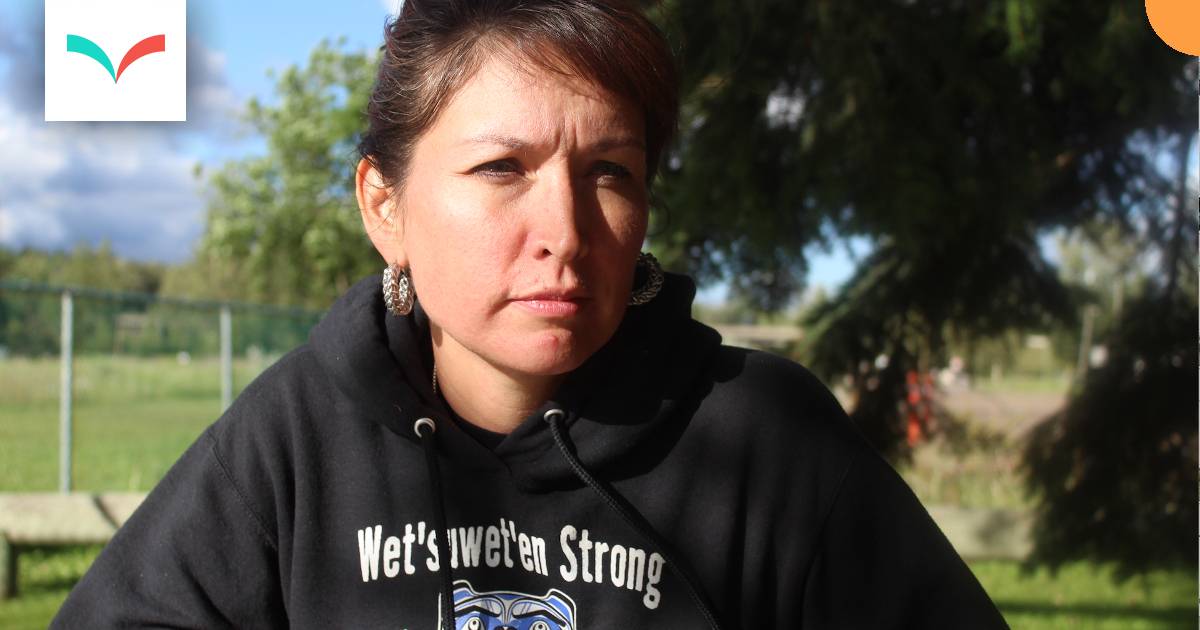
The sun is breaking through the rolling clouds that have brought heaps of rain to northern B.C. over several days in mid-July. Molly Wickham, also known by her Wet’suwet’en name of Sleydo’, stops in the rural town of Houston on the way to visit her mother in Smithers with her husband, Cody, and three children. She unloads her two-year-old daughter, Winïh, from her car seat in the truck. Winïh totters to catch up with her older sister Lily, 6, and brother, Liam, 11, as they race to frolic at a playground.
With her husband attending to the children, Wickham, dressed in a “Wet’suwet’en Strong” black hoodie and jeans, sits down at a picnic table nearby. She is part of the Gidimt’en Clan and her family live on its territory.
“You know, I never, ever want to take it for granted,” she says, referring to raising her children out on the yintah (Wet’suwet’en territory), about a two-hour drive up a mountainous road west of Houston, where the family has lived since Liam was a baby.
“I’m so in awe of them and so grateful for the way that they get to live. And so bewildered by how much they know.” She pauses and tucks a strand of her brown hair behind her ear.
“Just by living out there, by living on the land they know, and they understand more than I feel like I ever could because I didn’t grow up like that. It wasn’t instilled in me from childhood — I didn’t know the land, I didn’t learn that until I was in my thirties.”
Wickham’s mother, June, was taken from her birth parents as a baby and adopted into a non-Indigenous family as part of what is known as the Sixties Scoop. Her mother, despite being displaced from her Indigenous culture and traditions, taught Wickham and her older sister Jennifer to be proud of their Indigenous identity. But it wasn’t until Wickham was in university that she began the journey of reconnecting to her roots. She was far away from home, in Victoria, and planning to become a lawyer when she decided to take an Indigenous governance degree program. That course, and the revelations that came with learning about her Indigenous culture, led her to move to her home territory on the yintah.
Since then, Wickham and her Haida husband have devoted their lives to the reclamation of Indigenous knowledge, governance, law, and living on the land. But this way of life has come at a cost. (more...)
“Follow colonial laws or go to jail”

As much as 75 per cent of the world’s mining companies are headquartered in Canada — companies that frequently come under fire for violating human rights, ignoring Indigenous sovereignty, and seriously damaging the environment.
These companies have extraction operations on every continent, including Asia, the Americas, and Africa, and many projects are operating against the expressed wishes of the local Indigenous communities.
Many of those Canadian mining executives will be in Toronto this week at the world’s biggest mining conference, the Prospectors and Developers Association of Canada Convention 2022, June 13 to 15.
Mining watchdog groups are already calling it a "greenwashing” campaign. Many have been demonstrating in the streets outside.
“Mining doesn’t allow for a healthy future on this planet, and Pan American Silver’s proposed plans for Navidad project in Argentina will further exacerbate environmental degradation in the region”
MiningWatch Canada and Mining Injustice Solidarity Network have denounced the convention as a ludicrous attempt to distract from their colonial and capitalist destructive business — a business model that scientists say is also no longer justifiable in a climate emergency. (more...)
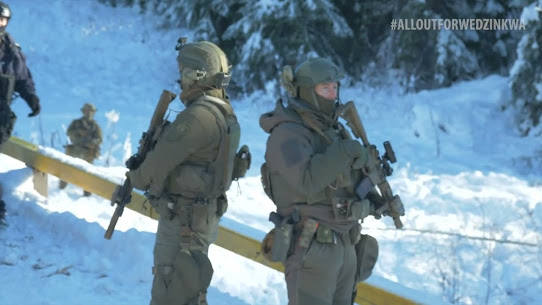
During a meeting with Royal Bank of Canada and City National Bank executives on February 25th, 2022 we closed the meeting by sharing footage of RCMP police violence and arrests against peaceful Indigenous land defenders over the last three years, as recently as November 2021.
RBC is funding the destruction of our yintah and way of life. Our Hereditary Chiefs made the following demands:

The following is a message from Onkwehon:we Grand River Mohawk women from the Turtle, Wolf and Bear clans to the people standing up for freedom against vaccine mandates.
"At this time I would like to remind you that we are spiritual beings having a human experience. We would like to acknowledge all the ones who listened to their intuition, their gut feeling, in knowing that these vaccines weren’t a thing that resonated with their being.
Thank you for having the courage to say “No” and stand up for what you believe. Continue to be mindful of your thoughts as we enter into these next few days. You are awakened, you are the light, you are the love of humanity. Love will always prevail. Let’s continue to hold each other up as more truth and justice come to light.
This message is for all our sisters, brothers, and allies across Turtle Island and to our honored, age-old international relations.
We send love and gratitude to all of the brave men and women who are holding the line, uniting together with kindness and compassion in their hearts for freedom, so that truth and justice may prevail.
Canada is still a crime scene, and all will be held on genocide. Grand River Mohawks are alive and well. Mohawks still hold the original six international treaties, and we are in the centre of the Covenant Chain.
As women we must remind the Canadian government of their pledge to the Grand River Mohawks and to the Onkwehon:we way of life. The [emergency measures] announcement today by Prime Minister Justin Trudeau is a breach of this trust.
Women are the allodial title holders. Even if the courts wanted to, they cannot provide the Canadian Government with a casa somasos.
Universal laws are supreme law of the land and no legislative acts will ever supersede them. A formal notice will be sent to the Honorable Governor General Mary Simon ordering her to uphold her fiduciary responsibilities and invoke the appropriate Criminal Codes that we see fit under Royal Assent and international law. Implicating the Prime Minister Justin Trudeau, the Deputy Prime Minister and Finance Minister Christia Freeland, and the Premier of Ontario Doug Ford.
In peace, freedom, and truth, take care, stay safe. We love you."
Note: the Latin term “Nemo dat quod non habet” that appears as text in the video means “no one can give what they do not have.” It is a legal rule, sometimes called the nemo dat rule, that states that the purchase of a possession from someone who has no ownership right to it also denies the purchaser any ownership title to it. (Source: Wikipedia).
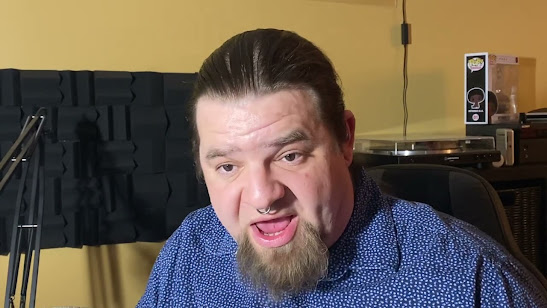
“They’re liars. They’re lying. But they’re afraid. They’re weak right now. They’re weak, and they’re pretending that they’re strong. Stand up.”
Kanyenkehaka (Mohawk) is from the Tehanakarineh family of the Bear Clan. His home is in Tyendinaga Mohawk Territory, but he currently resides at the Six Nations of the Grand River Territory (near Hamilton, Ontario). He is an Onkwehon:we (Indigenous) man and belongs to the Kayenkehaka Nation, not the Canadian or English nation. His people have kept their ways and traditions, and despite generations of mistreatment at the hands of the Canadian government, they remain a separate, allied Nation with their own rights and responsibilities to creation.
“For all of you who don’t have a clue what I’m talking about, maybe you’re new to this country. They didn’t teach you that Indigenous people own these lands. They’ll tell you that it’s theirs. It’s Canada’s wonderful free place. It was only free because they stole things. I’m talking to all the brown people in the cities that didn’t want to go and support the truckers because they thought they were racist. Well, the Liberal Government’s racist and so is the Conservative Government. The entire government of Canada is racist. And the RCMP are racist. Let’s face the facts the RCMP are just as much a culprit in the in the theft of the indigenous children that got sent to residential schools, because they were the collectors.”
Addressing Trudeau: “Maybe you didn’t, but I suspect you did, [have] the audacity to encourage the smear campaigns of swastika flags and white supremacy – but Canada’s built on white supremacy. Literally, built on white racism. The Canadian flag, that red and white maple flag has, as nasty of blood and history on it, as a swastika.”
“… well, it’s pretty simple. They said drop the mandates, and you need to quit. You can do that tomorrow… they want you to resign. They don’t have any confidence in you. You can’t even go anywhere in public without them throwing rocks at you and booing. Your people don’t love you. You can resign.”
“but that’s still our territory… Doug Ford, you don’t have any right to claim it, and you don’t have any right to make decisions, or to say ‘well, you can have your rights but we’re going to supersede them.'” ” The fuck you will.”

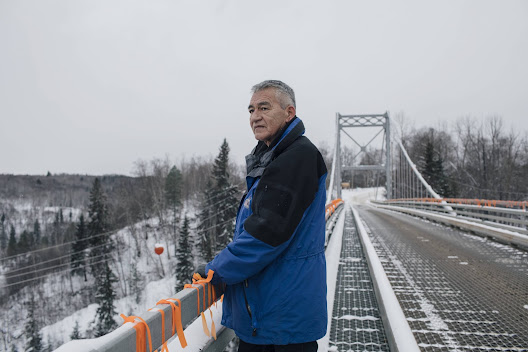
A pure and sacred river lies at the heart of opposition to the Coastal GasLink pipeline
Winding through mountainous wilderness in the heart of Wet’suwet’en territories is a glistening, sacred river. The Wet’suwet’en call it Wedzin Kwa — “the blue and green river” — and cherish it for its purity and healing powers.
This river system has been revered by the Wet’suwet’en since time immemorial. Ancient village sites around and along the Wedzin Kwa attest to the rich history and long connections the Wet’suwet’en have to this waterway. For millennia the clans of the Wet’suwet’en have depended on the river and the sustenance it provides — in particular, the different species of salmon that traverse this inland channel and its tributaries to spawn through most of the year.
“There’s one area you’ll walk through and you can feel the spirit from the water. You can feel it for probably just a second and then it’s gone. It’s just letting you know that it’s sacred.”
Elder Betty Joseph, 67, from the Lik’silyu Clan, is known as one of the greatest living fisherwomen among the Wet’suwet’en. She grew up helping her grandparents harvest salmon in the summer months along the Moricetown Canyon, but it wasn’t until she turned 21 that she discovered she had a gift.
“My boyfriend went down with my kids to go fishing at five o’clock in the morning,” she recounts from her two-storey home on the Witset First Nation on a frigid January afternoon.
“They never came back so I went down to bring them some lunch. I was laughing at my boyfriend because he hadn’t caught anything. So I put a hook into the water and started pulling and I caught something pulling on the line. He was mad because he never caught one.” She chuckles, her wrinkled eyes gleaming with delight. (more...)
The last of the untamed: Wedzin Kwa and the Wet’suwet’en fight to save her
Related:
'We are the power' Canada's Indigenous land defenders pledge to fight on
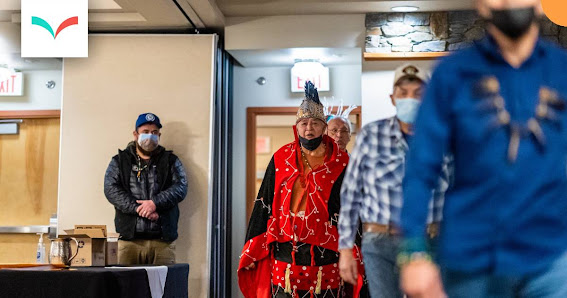
The conflict over the Coastal GasLink project is about more than the fate of a single pipeline or the territory of one Indigenous nation. The precedent set here will have far-reaching consequences, and Indigenous nations and leaders from across Turtle Island are paying close attention.
The hereditary chiefs of the Wet’suwet’en Nation hosted a Peace and Unity Summit in the town of Smithers on Jan. 15. Wet’suwet’en leaders and representatives of other Indigenous nations gathered to offer solidarity and support in the fight against the Coastal GasLink pipeline.
The Wet’suwet’en argue that their Indigenous and human rights, and rights to their territories, are threatened by the multibillion-dollar project, which is backed by the provincial and federal governments.
Their fight to stop the LNG pipeline has been gruelling, stretching over several years and multiple police raids of resistance camps on unceded Wet’suwet’en lands. Militarised police patrols and harassment of those they encounter have become a regular occurrence on the Wet’suwet’en Yintah (territory). Officers have violently arrested and jailed numerous land defenders under the authority of a colonial court’s injunction.
The latest raid, in November, saw over a dozen land defenders and two journalists arrested at gunpoint. The RCMP appeared to be gearing up for another raid this month, until the land defenders made the strategic choice to withdraw from Coyote Camp. The camp had blocked access to a Coastal GasLink drill site they will use to bore under the sacred Wedzin Kwa (Morice) river.
At the time Sleydo’, part of the Gidimt’en (Bear) clan of the Wet’suwet’en Nation, stated that land defenders intended to block drilling under the river by any means necessary, but did not want to provoke another raid that would lead to more arrests and more land defenders being barred from their own territory by bail conditions. (more...)
‘I can never stop being Wet’suwet’en:’ Summit strengthens alliances against CGL pipeline

The contradictions couldn’t be more glaring.
While recent laws passed by the federal and the British Columbia governments pledge to transform relationships with Indigenous peoples, their actions indicate otherwise.
For example, in northern B.C., the Wet’suwet’en Hereditary Chiefs of all five clans oppose incursion into their traditional, unceded lands by the Coastal Gaslink pipeline.
While some elected band councils in Wet’suwet’en territory support the project, both Indigenous law and the Supreme Court of Canada recognize the hereditary chiefs as stewards of the 22,000 kilometres of central B.C. that is Wet’suwet’en yintah (territory).
Conflict with the RCMP in B.C. has shone a bright light on this issue. The RCMP has invaded the camps of the hereditary chiefs three times in three years, the most recent in November 2021. Twenty-nine people, including two accredited journalists, were arrested in a multiday invasion last month. When the arrest footage was eventually released, it showed RCMP officers pointing assault rifles at unarmed Indigenous people.
At the heart of the matter is a contradiction about the rule of law.
The narrative offered by the federal and provincial governments is that since the B.C. Oil and Gas Commission granted a permit, and a court granted Coastal GasLink’s request for an injunction against blockades, the police are simply upholding the rule of law. They portray the hereditary chiefs as a small band of dissident troublemakers defying a court order.
But hereditary chiefs are not protesters—they are land defenders.
And they are acting in accordance with Wet’suwet’en law, which predates colonization, and the United Nations Declaration on the Rights of Indigenous Peoples. The UN Committee on the Elimination of Racial Discrimination has also weighed in, issuing a decision in 2019 calling for Canada to withdraw police forces and stop pipeline construction.
It is clear that governments are choosing which law to uphold, prioritizing the law that protects oil and gas corporations rather than the law that protects the rights of Indigenous peoples. (more...)
Canada chooses oil companies over Indigenous peoples

We hear from Skyler Williams, Layla Staats and Logan Staats - Mohawks from Six Nations of the Grand River and part of the Haudenosaunee Confederacy. They share their experiences travelling to Wet'suwet'en territory to help Wet'suwet'en Nation hereditary leaders, clan members and relatives protect the lands and waters from destruction by Coastal Gaslink pipeline.
They shared some very difficult experiences related to the violence, taunting and degrading treatment they received in the hands of the RCMP, despite being unarmed and peaceful land defenders. Their comments are fair political comment and do not necessarily represent their legal positions on any of these matters.
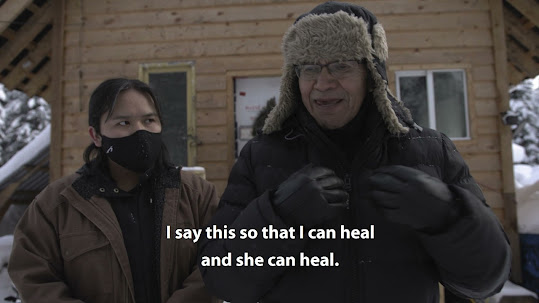
In the words of Hereditary Chief Woos', "What is violence? A loaded gun pointed at your head."
The RCMP were created to suppress and control Indigenous people. They are still being used for this purpose. They came into our villages, burning and pillaging, a century ago and they do the same now.
The colonial state laws are designed to work for the RCMP and those in power, and to keep the majority pacified and the oppressed silent and afraid.
But we are not afraid. We are not alone.
We know the world is watching and that they see the investors and the state behind this violence and corruption, we know the world sees this as it is - an extension of the residential school and Indian Act system, forcing their version of consultation with bulldozers and armies of mercenaries.
This is Canada's legacy. Reconciliation at gunpoint.
Our legacy will be standing proud on our Yintah, with the clean water of the Wedzin Kwa behind us.
Stand with us.

Sleydo' speaks about the strategic retreat of Coyote Camp, as RCMP mobilize to invade unceded #Wetsuweten land again: "Our warriors are not here to be arrested. Our warriors are here to protect the land and water and will continue to do so at all cost."
#AllOutForWedzinKwa

Marked Culmination of a Long Process of Genocide That is Still Sugarcoated in Most History Textbooks
“Our nation was born in genocide. We are perhaps the only nation which tried as a matter of national policy to wipe out its indigenous population. Moreover, we elevated that tragic experience into a noble crusade. Indeed, even today we have not permitted ourselves to reject or feel remorse for this shameful episode.”
Those words were spoken by Martin Luther King Jr in his 1963 book “Why We Can’t Wait.”
Of course, the U.S. was not the only nation who tried as a matter of policy to wipe out its indigenous people–Canada, Australia and others did the same. But the thrust of what King was saying is correct.
The month of December is filled with various kinds of celebrations and festivities; however, there is one event that always seems to be conveniently overlooked by the wider society. This December 29 marks the 131st anniversary of the massacre of the Native people at Wounded Knee. Wounded Knee is located on the Pine Ridge Reservation in South Dakota.
What Whites as a collective do not understand, approve, or develop they demonize, ridicule or attack. Part of the background to the Wounded Knee massacre, lies in the spiritual of the Ghost Dance Movement practiced by some of the Native Nations, among them the Sioux people. After the surrender of the Sioux Nation in the 1876-1877 war, the government drove the Sioux out of Nebraska, all that was left to them was 35,000 square miles of almost useless land. (more...)
131 Years Ago Today, the U.S. Army Massacred Native Sioux at Wounded Knee

...The Tyee reports: “One month after dozens of arrests, supporters of Wet’suwet’en Hereditary Chiefs have reoccupied a worksite on the Coastal GasLink pipeline route in the nation’s territory. The group announced Sunday they had returned to occupy Coyote Camp and block access to a strategic pipeline worksite.”
“Wet’suwet’en Hereditary Chief Na’Moks said today he visited the site on Sunday after Coastal GasLink security had been asked to leave.”
“He added that a tiny home, school bus and wall tents removed from the camp during the arrests had been returned and are now occupied.”
That article also notes: “Na’Moks said there was no Coastal GasLink security or RCMP at the site during his visit… He said no work was underway at the site, although it appeared site preparation had continued since the arrests a month ago.”
There may be 10-12 land defenders at the site now.
The CBC article on this adds: “[Gidimt’en Checkpoint media coordinator Jennifer] Wickham said the people who re-occupied the area Sunday are not the same ones who were arrested in November.”
Those arrested on November 18-19 will be in court on February 14, 2022.
And the Canadian Press reports: “The RCMP say they are investigating allegations that protesters threatened security officials, set off flares and damaged vehicles at a drill site for the Coastal GasLink pipeline in northern British Columbia.”
Wickham questions this account and says: “We have heard false testimony from the RCMP before about us.” She also says that the land defenders at Coyote Camp are anticipating another police action “against unarmed Indigenous people.” (more...)
Day 3: Wet’suwet’en land defenders occupy drill pad site, anticipate fourth RCMP raid
Related:
One Month after Arrests, Wet’suwet’en Return to Block Pipeline
‘Dangerous precedent’: pipelines, land defenders and the colonial policing of Indigenous nationhood
Wet’suwet’en hereditary chief takes fight against Coastal GasLink all the way to the banks
A 'lingering evil': From residential schools to murdered women
Toronto activists today in solidarity with @Gidimten land defenders & #WetsuwetenStrong called on all funders of the #CoastalGasLink pipeline to divest. @RBC is the largest bankroller of fossil fuels in Canada. #divestcgl pic.twitter.com/sb5km4HwCj
— Martin Reis (@BikeLaneDiary) December 22, 2021
